


Trump Made an Effort in 2025 to Resurrect the U.S. Empire
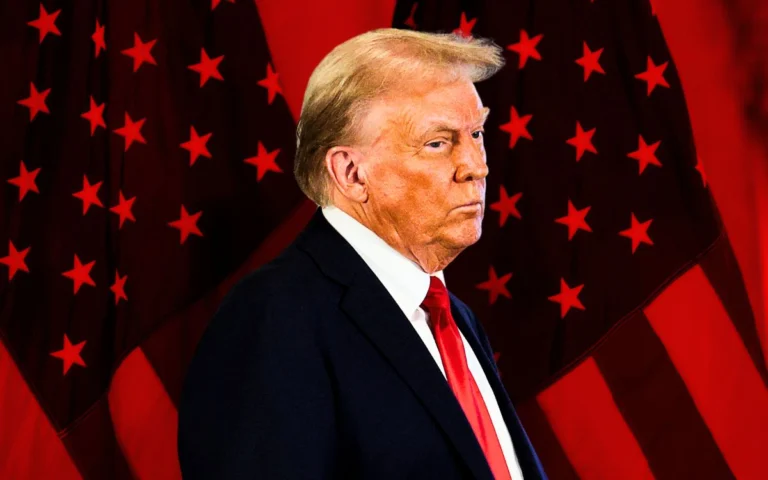
Donald Trump in the center, with the American flag in the background. Photo: Aristegui Noticias
January 21, 2026 Hour: 2:40 pm
Aggressive interventions and punitive tariffs dismantle the global multilateral order during the second term.
The White House is branding Donald Trump’s second term (2025–2026) as a “golden age” of American power, but what is emerging instead is a brutal, imperial neo‑fascism built on permanent war, economic blackmail, and open contempt for international law.
RELATED:
Amnesty: Trump Administration’s AI Tools Target Migrants and Pro-Palestinian Supporters
From Latin America to the Middle East and Africa, Washington is replacing multilateralism with a politics of raw force, turning the Western Hemisphere into a resource colony and the rest of the Global South into a battlefield.
At the center of this shift is the Donroe Doctrine, a hardline fusion of Trump’s personal nationalism with the 19th-century Monroe Doctrine, now updated for an age of drones, sanctions, and financial warfare.
Its core message is simple and devastating: the resources, governments, and people of the Americas exist first and foremost to serve the strategic and corporate interests of Washington.
Donroe Doctrine: Force over diplomacy
Trump’s second term has dispelled any illusion that the United States still views diplomacy as the primary means of resolving conflicts in the region.
Under the Donroe Doctrine, military power has become the primary language of foreign policy, especially toward Latin America.
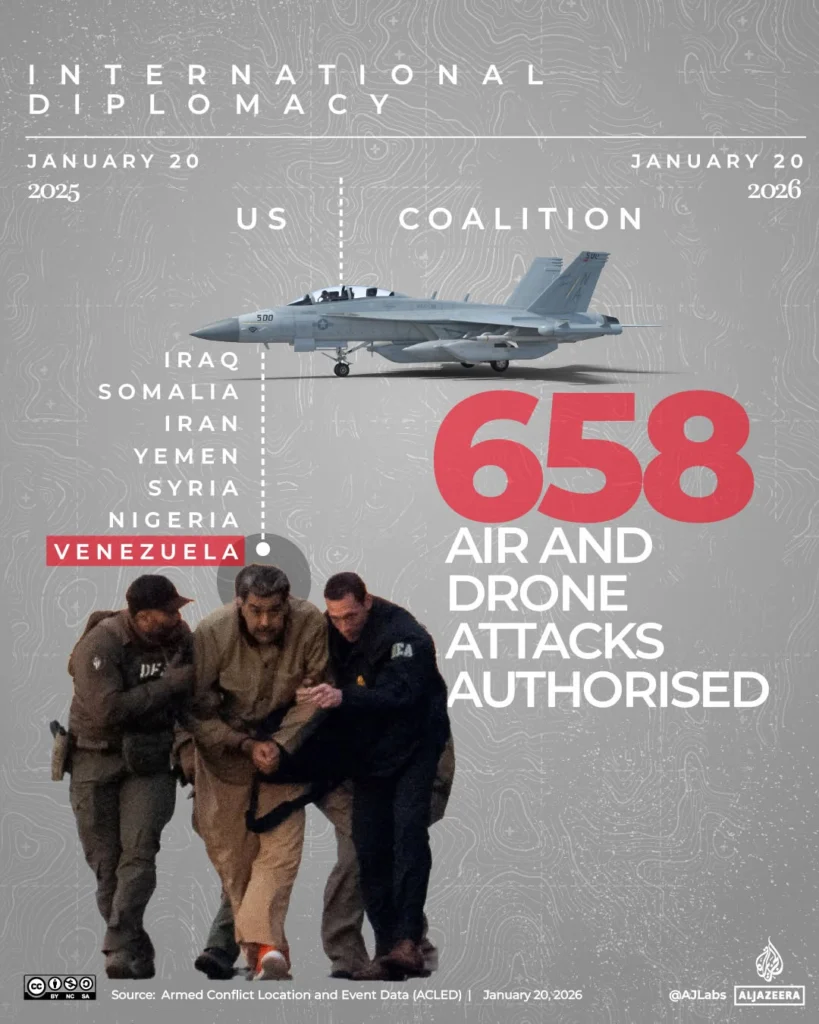
The clearest and most chilling example is “Operation Absolute Resolution,” the January 3, 2026, assault on Venezuela.
Under the pretext of combating narcoterrorism, U.S. special forces stormed Caracas and kidnapped President Nicolas Maduro and First Lady Cilia Flores.
This was not an isolated overreach, but the culmination of a strategy aimed at dismantling the idea of Latin America as a “Zone of Peace” and openly declaring that a country’s sovereignty is expendable when it clashes with U.S. interests.
The Donroe Doctrine functions as a kind of “Trump Corollary” to the Monroe Doctrine: it asserts that the United States has an exclusive right to intervene anywhere in the Western Hemisphere to “protect” its security or economic interests.
The December 2025 National Security Strategy even frames access to critical minerals and energy, especially in the Southern Cone, as a matter of national defense, treating any country that signs strategic infrastructure deals with China or Russia as a security threat.
This colonial revival is not limited to Latin America. From renewed talk of annexing Greenland “for global security” against China and Russia to the bombing of facilities in Iran and a heightened US naval presence across the Caribbean and beyond, Washington is asserting a 19th-century right to redraw borders and dictate terms wherever its corporations see opportunity.
Economic warfare: tariffs as a weapon
If the Pentagon is the big stick of the Donroe Doctrine, protectionism is its economic hammer. The 2025–2026 period has been marked by radical economic nationalism in which tariffs, sanctions, and trade threats are deployed not to build shared prosperity, but to discipline governments and lock in US dominance.
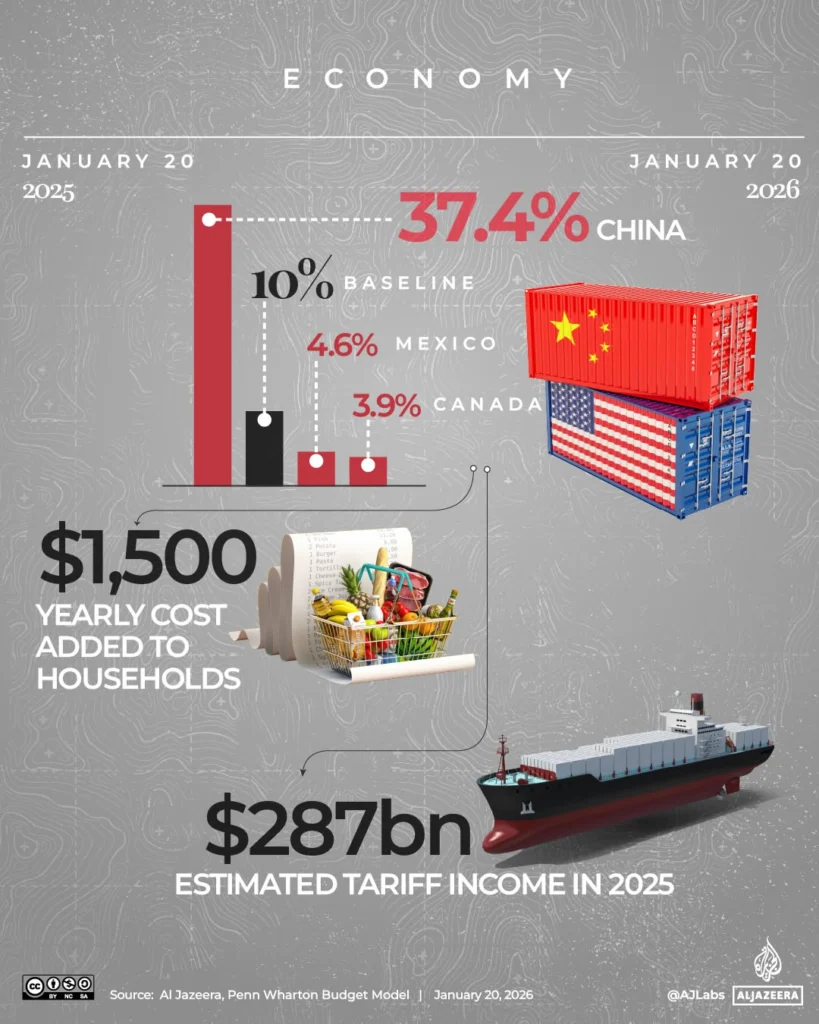
Trump has driven the average U.S. tariff rate from 2.4% to around 16.8% in just one year, levels not seen since the 1930s.
This full-spectrum trade war targets not only rivals like China, but also formal allies. Mexico and Canada were hit with 25% tariffs within a month of Trump taking office again, under the pretext of “border security,” in open violation of the USMCA agreement.
Across Latin America, countries such as Brazil, Colombia, and Argentina have faced tariffs between 10% and 50%, used as leverage to force them to distance themselves from Beijing and accept Washington’s conditions.
This economic offensive is tightly linked to resource control. The 2025 National Security Strategy explicitly declares priority access to the Lithium Triangle in South America, rare earth minerals in Africa, and regional oil and gas as vital to U.S. national security, clearing the way for state‑backed monopolies.
Any government that signs major infrastructure, port, or 5G agreements with China is quickly punished with sanctions or trade restrictions, forced to choose between sovereign development plans and U.S. approval.
Security and social control: a regime of fear
Under the Trump Corollary, the government is replacing the idea of collective security with a transactional and punitive model that treats entire populations as collateral damage.
The Western Hemisphere is becoming a testing ground for high‑tech surveillance, targeted killings, and militarized policing aimed at migrants, dissidents, and communities of color.
A key turning point was the January 2025 executive order designating Latin American cartels as Foreign Terrorist Organizations (FTOs).
This move handed the Pentagon a legal blank check to conduct extraterritorial military operations without a formal declaration of war against the states where these groups operate.
Under this cover, the administration has unleashed a wave of “surgical strikes” and large‑scale deployments that already surpass previous administrations in frequency and reach.
Venezuela again stands as a stark example: before the Caracas raid, Washington imposed a naval blockade in the Caribbean under the banner of intercepting “drug‑trafficking boats,” using it as a pretext to deploy aircraft carriers and nuclear‑powered submarines in the region.
Beyond Latin America, more than 600 airstrikes were authorized in 2025 alone in countries such as Somalia, Iraq, Syria, Nigeria, and Yemen, justified as efforts to protect “Christian communities” or destroy ISIS and Al‑Shabaab logistics, even as analysts point to trade routes and strategic chokepoints as the real objectives.
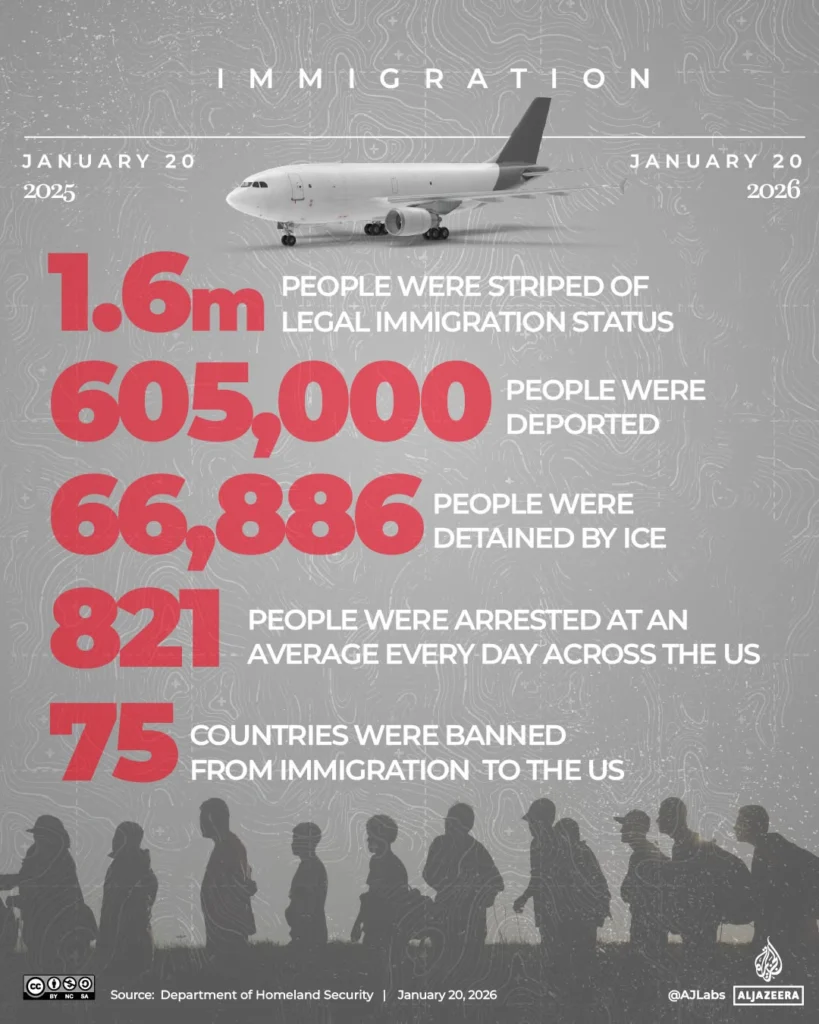
Inside the United States, this external militarism is mirrored by an internal war on migrants and social rights. The administration’s “Immigration Offensive” has produced over 70,000 arrests in its first year, with ICE raids moving deep into the interior and tearing apart communities in states like Minnesota.
Despite the official “Golden Age” messaging, 52% of the population disapproves of Trump’s immigration policies, and a majority of working‑class people see the cost of living as unsustainable.
Global projection: disruption and backlash
Trump has abandoned any pretense of acting as a global stabilizer and instead embraced the role of “Great Disruptor,” demanding that the world effectively pay rent for existing under the shadow of US power.
What Washington frames as a necessary reordering of the global system looks, from the Global South, like open extortion backed by overwhelming military force.
This aggression is generating a powerful backlash. BRICS+ has emerged as a key pole of resistance, strengthened by Trump’s threats to cut countries off from the SWIFT financial system and weaponize the dollar.
Brazil, China, and other members have accelerated de‑dollarization, expanding the use of national currencies and alternative payment mechanisms in their trade, and building a parallel financial architecture that offers shelter from US sanctions.
In Latin America, the fall of Venezuela has left a politically fragmented landscape, but it has also pushed governments to look eastward with new urgency.
Washington’s double game, talking about democracy while sponsoring coups, blockades, and invasions, has driven more states to explore deeper ties with BRICS, the Eurasian corridor, and other non-Western alliances.
2026: resistance or submission
As 2026 unfolds, the world stands at a fork in the road. On one path lies a normalized Donroe Doctrine, in which military incursions, economic blockades, and deportation raids become business as usual; on the other stands a growing wave of anti-hegemonic resistance determined to build a multipolar alternative.
This so-called “reordering” must be named for what it is: a project of imperial neo‑fascism that relies on the destruction of sovereignty, the plunder of natural resources, and the criminalization of migration and dissent.
The “Golden Age” promised by Washington is, in reality, a cold, metallic age of missiles, sanctions, and mass surveillance.
The real story of 2026 will not be written in the speeches of the White House, but in the resilience of communities, movements, and nations that refuse to be subordinated.
Sources: Al Jazeera – TeleSUR – Jacobin Magazine – Xinhua – France 24 – The Conversation – The New York Times – The Diplomat
Author: Silvana Solano
Source: TeleSUR